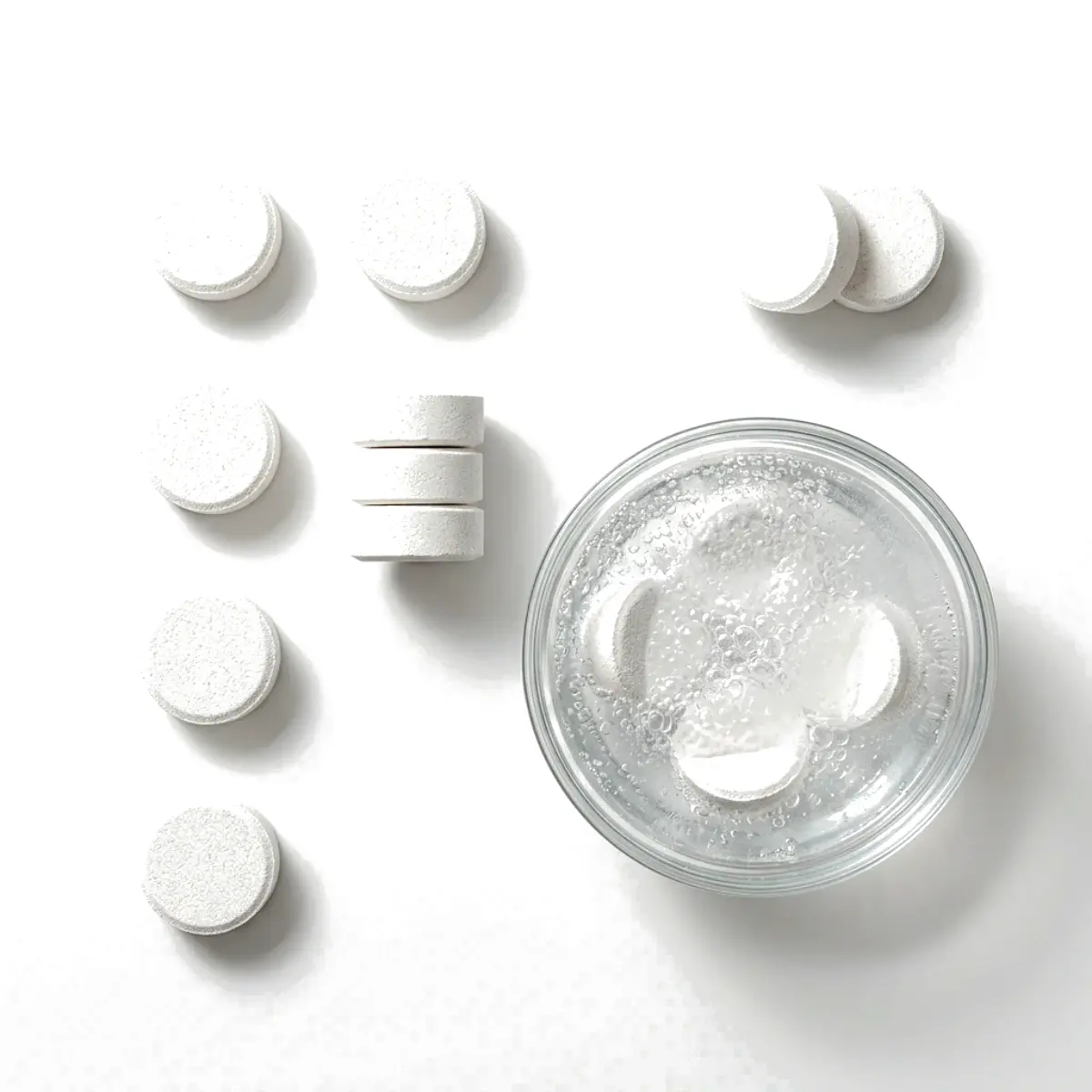

Cleaning tablets fizzing in the package? Learn how humidity triggers the acid-carbonate reaction, why packs swell, and how to store tablets dry.
You open a tub of toilet bowl tablets and find them stuck together. Or a foil pouch looks pillowy, as if someone pumped air into it. Neither means the product is "bad" in a dramatic sense. Something did happen early, though.
- Moisture starts the acid–carbonate reaction long before the tablet reaches water.
- That reaction makes its own water, so a small leak tends to grow into a bigger problem.
- Sodium percarbonate releases oxygen and can puff a sealed pack even when nothing fizzes.
- Barrier packaging and stability testing set the real shelf life.
- Cool, dry, sealed storage prevents most failures.
The Short Answer: Moisture Got In Before You Did
Cleaning tablets swell or fizz in the package because water vapor reached them early. Even humid air is enough to start the reaction between the dry acid (often citric acid) and the carbonate base (sodium bicarbonate). The reaction gives off carbon dioxide. Tablets containing oxygen bleach also release oxygen, and the trapped gas inflates the pack.
For a consumer, a bloated pack usually means weaker cleaning. Some of the fizz has already been spent. For a brand, it points to a weak link somewhere in the chain: formula water content, the pressing environment, seal quality, or the film itself.
Is It Just Humidity, or a Defect?
Mild surface tackiness on an opened tub that sits in a steamy bathroom is normal exposure. A sealed pack that arrives already damaged points to a packaging or production fault. These signs help you tell which one you have:
- Sticky or glossy surface: the tablet absorbed moisture from the air.
- Crumbling edges: the binder was weakened, or the tablets were pressed too damp.
- Gas-bloated film: a reaction is happening inside a sealed pack, so suspect the seal or the formula.
- White powder residue: part of the tablet has already reacted, leaving salt behind.
The Chemistry of Premature Effervescence
Most fizzing cleaning tablets contain a dry acid and a carbonate base. While both stay dry, nothing happens. Once water dissolves a little of each, they react:
C6H8O7 + 3 NaHCO3 → Na3C6H5O7 + 3 H2O + 3 CO2
Citric acid plus baking soda gives sodium citrate, water, and carbon dioxide. That CO2 is the fizz you want in the toilet bowl. You don't want it in the pouch.
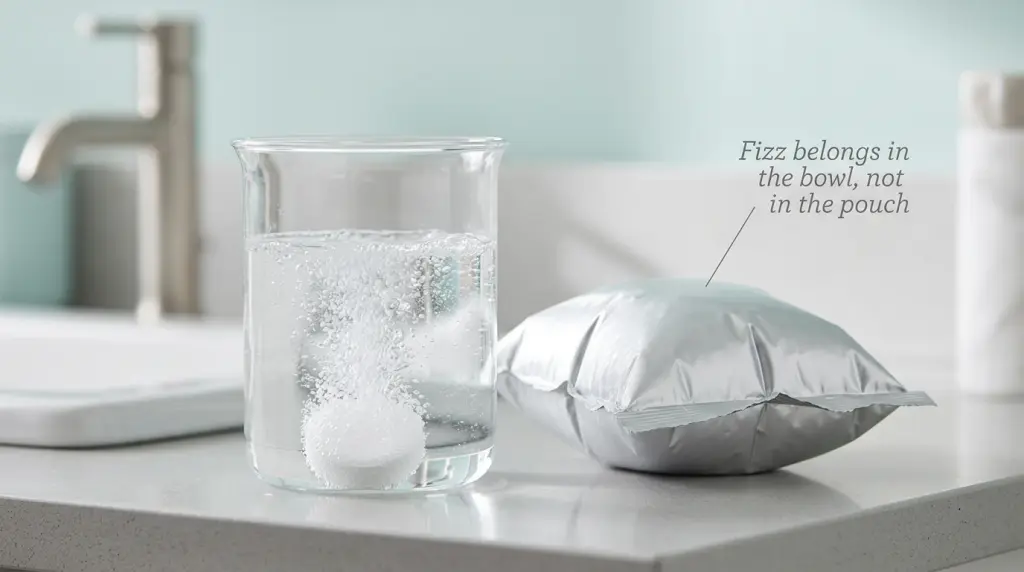
Why a Tiny Amount of Water Becomes a Chain Reaction
The equation shows the problem. The reaction produces water, and that water dissolves more acid and base, so the reaction keeps going. Formulators track water activity rather than total moisture, because only free water drives the reaction. Every acid–base blend also has a critical relative humidity. Above that level, the powder pulls vapor from the air instead of staying dry.
Swelling Without Fizzing: Oxygen-Releasing Ingredients
Sodium percarbonate is sodium carbonate combined with hydrogen peroxide. Heat and humidity slowly break it down, and it releases oxygen. A sealed tub can bulge even though the tablets look intact.
| Ingredient | CAS | Function | Moisture sensitivity | GHS note |
|---|---|---|---|---|
| Citric acid anhydrous | 77-92-9 | Acid | Hygroscopic | H319 |
| Sodium bicarbonate | 144-55-8 | CO2 source | Reacts once wet with acid | Generally not classified |
| Sodium carbonate | 497-19-8 | Alkali builder | Absorbs water, forms hydrates | H319 |
| Sodium percarbonate | 15630-89-4 | Oxygen bleach | Breaks down, releasing O2 | H272, H302, H318 |
| Sulfamic acid | 5329-14-6 | Descaling acid | Low hygroscopicity | H315, H319, H412 |
Where the Moisture Actually Comes From
Moisture usually gets in by one of three routes. Some is locked in before pressing, some seeps through the pack, and the rest arrives after opening. Think of a dishwasher tub parked beside a steaming kettle, or toilet tablets on a bathroom shelf that gets a hot shower every morning.
Residual Moisture From Raw Materials and Pressing
Anhydrous citric acid and sodium bicarbonate pick up water quickly in a humid compression room. Careful plants press in dehumidified areas and check each incoming lot against its certificate of analysis (COA), which reports water content or loss on drying. A slightly wet lot can look fine at release and still puff weeks later.
Packaging Barrier Failure
Weak heat seals, pinholes at creases, and films that are too thin all let vapor through. Water-soluble PVA wraps are a special case. They are designed to dissolve, so they absorb ambient moisture and rely entirely on the outer pack to stay dry.
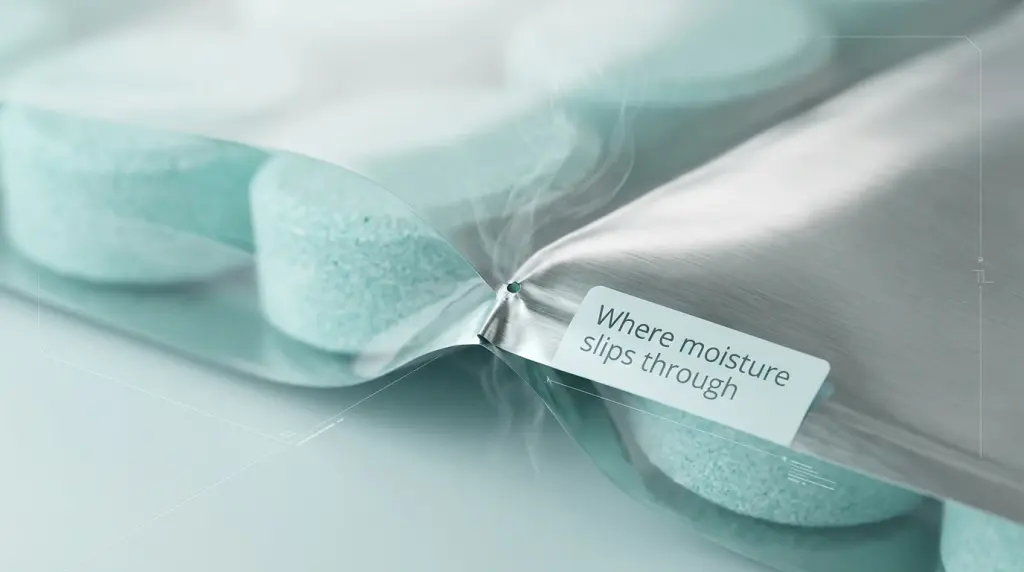
| Format | Relative WVTR | Typical use | Weak point |
|---|---|---|---|
| Cold-form alu-alu blister | Lowest | Premium single doses | Cost, larger footprint |
| Foil sachet | Very low | Single or small multi-packs | Seal quality, crease pinholes |
| PCTFE (Aclar) / PVDC blister | Low | Visible-product blisters | Depends on film thickness |
| Tube with desiccant cap | Low to moderate | Stacked effervescent tablets | Desiccant saturates with frequent opening |
| PVC blister | Moderate to high | Budget packs | Poor vapor barrier on its own |
| PVA film wrap | High (by design) | Dishwasher tablets | Needs a barrier outer pack |
| Resealable tub | High once opened | Bulk dishwasher or toilet tablets | Lid gaps, repeated opening |
How Manufacturers Test Tablet Stability and Packaging Barriers
Picking a good film is only half the job. The other half is proving it protects the actual tablet over time, in heat and humidity.
Accelerated and Long-Term Stability Conditions
Careful producers borrow their climate settings from the pharmaceutical guideline ICH Q1A(R2). Long-term studies run at 25°C/60% RH. Accelerated studies push packs to 40°C/75% RH. That harsher condition exposes weak seals and moisture-sensitive blends in weeks rather than months.
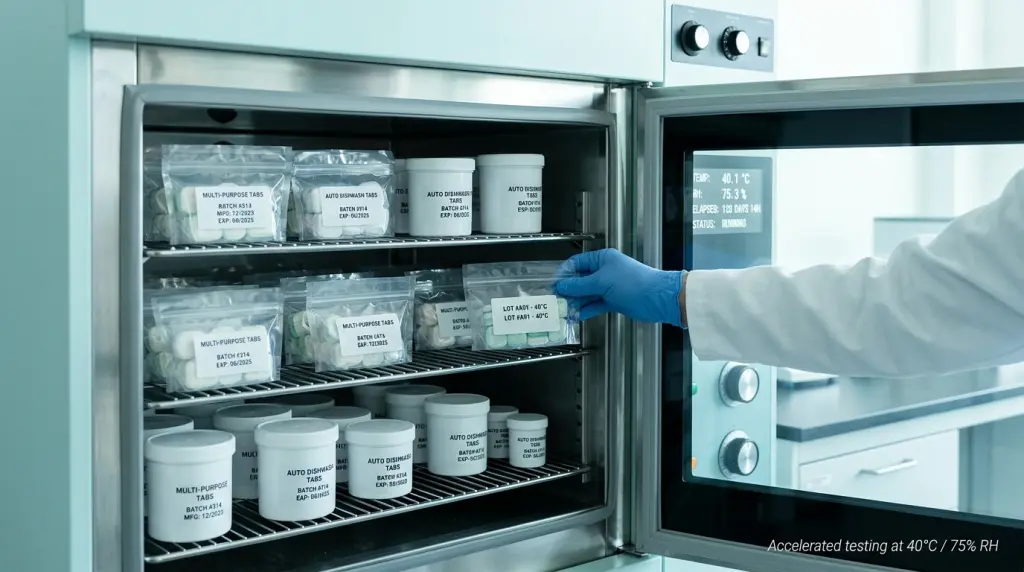
Key Stability and Barrier Tests
| Test | Standard or Method | What It Reveals |
|---|---|---|
| Karl Fischer water content | Volumetric or coulometric KF titration | Water in raw materials and finished tablets |
| WVTR | ASTM F1249 / ASTM E96 | How much water vapor the film lets through |
| Seal strength and leak integrity | ASTM F88 peel test; ASTM D3078 bubble test | Weak, channeled or incomplete seals |
| Pack-swelling and gas checks | Visual and dimensional inspection at each pull point | Gas from early effervescence or percarbonate breakdown |
| Disintegration time after storage | Timed dissolution in water at a fixed temperature | Whether the tablet still fizzes and cleans properly |
What a "Pass" Really Looks Like
A single clean result at week four proves very little. You want trend data, with moisture, hardness and fizz time logged at several pull points. Ideally those lines stay flat.
Scope matters too. A pack that held up at 40°C/75% RH tells you nothing about a container sitting at a hot Gulf port, unless someone actually tested that condition.
How to Store Cleaning Tablets So They Don't Activate Early
Once a pack leaves the shelf, how it is stored at home matters more than any lab test. The goal is to keep moisture out, keep the temperature steady, and keep the barrier the manufacturer chose intact.
Storage Rules That Actually Work
- Keep them away from the sink, dishwasher steam, and the bathroom. A dry hallway cupboard works better than the cabinet under the sink.
- Reseal the pack immediately after use. Squeeze out excess air before you close a zip pouch.
- Leave desiccants in place. That small sachet is part of the packaging. It is not waste.
- Avoid heat sources and car trunks. Heat speeds up percarbonate breakdown, and temperature swings can cause condensation inside the pack.
What to Do With a Swollen or Fizzing Pack
Treat a bloated pack with some caution, because the gas inside may include oxygen from peroxide-based ingredients.
- Open it in a well-ventilated area, pointed away from your face.
- Keep it out of reach of children and pets.
- Don't combine the contents with other cleaners, especially chlorine bleach.
- Photograph the pack and its batch code, then contact the brand for a replacement.
Common Mistakes Consumers and Brands Make
Most moisture failures trace back to a handful of habits. Some happen in a kitchen drawer and others in a procurement meeting. Each one below comes with its fix.
- Decanting tablets into decorative open jars. A glass apothecary jar on the counter lets room air reach the tablets every day. Fix: keep the tablets in their original barrier pack and set that pack inside the jar if you like the look.
- Reaching in with damp hands. One wet fingertip can start a sticky patch that spreads through the whole tub. Fix: dry your hands first, or tip a tablet out instead of grabbing one.
- Buying a jumbo pack for a slow-use product. Every time you open it, a little more humid air gets in. Fix: buy a pack size you'll finish within a few months.
- Swapping to a cheaper film with no data behind it. A thinner laminate can look the same and still let far more water vapor through. Fix: ask for WVTR results and stability results on the new material before you approve it.
- Leaving out the desiccant to save cost. Fix: specify a desiccant sized to the pack's headspace and to how long it needs to last on the shelf.
- Ignoring the shipping route. Container loads that sit through a humid summer crossing can pick up condensation. Fix: plan shipments by season and line pallets or cartons where the route is humid.
Getting It Right From Formulation to Shelf: How We Can Help
A shopper can keep a tub dry at home. They can't fix a weak seal or a damp lot of citric acid. That responsibility belongs to the brand and the factory behind it. At Boymay, we have made bath bombs, shower steamers and cleaning tablets since 1995, so moisture control is part of every stage of production, not a fix added at the end.
- Raw material checks: every lot of acid and carbonate is checked against its COA, and current SDSs are kept on file.
- Humidity-controlled pressing: carried out across 16 automated lines in our 40,000 m² factory.
- Packaging matched to the route: options range from foil sachets to tubes with desiccant caps, chosen for the climate the product will travel through.
- Stability testing support: testing at long-term and accelerated conditions before launch.
- Compliance documentation: labels and documents aligned with REACH and GHS, backed by GMP, ISO, FDA and SMETA credentials.
Orders start at 1,000 units. Custom samples usually take 7–14 days, and bulk production takes 25–30 days. Contact us to request samples, a stability data pack, or a packaging consultation for your next formula.
FAQ
Q: Are swollen cleaning tablets still safe to use?
A: Usually, if they still dissolve normally. Open the pack outdoors first, because the trapped gas may contain oxygen.
Q: Why do dishwasher tablets stick together?
A: Steam softens their surfaces. When they dry again, they fuse together.
Q: Can I add a desiccant packet?
A: Yes. A silica gel sachet helps keep a resealed tub dry.
Q: Does refrigerating them help?
A: No. Cold packs collect condensation as soon as they are opened.
Q: What packaging keeps them driest?
A: Cold-form alu-alu blisters or sealed foil sachets.